
 Share
Share


Indigenous Cultural Safety, Cultural Humility and Anti-Racism
Indigenous Cultural Safety, Cultural Humility and Anti-Racism
The College believes that cultural safety and humility are vital for the provision of fair and equitable health services, as well as the creation of a healthcare environment free of racism and discrimination, where individuals feel safe and respected.
Recent News and action
| Date | Link |
|---|---|
| June 19, 2025 |
National Indigenous Peoples Day & National Indigenous History Month |
| September 19, 2025 |
Message from the Registrar and CEO: Learning Through Listening |
| June 11, 2025 |
Message from the Registrar and CEO: National Indigenous History Month |
| March 21, 2025 |
Journeying Toward Cultural Understanding: A Collaborative Experience in qathet |
| March 13, 2025 |
New Indigenous Cultural Safety, Cultural Humility and Anti-Racism Continuing Education Requirements |
| Sept. 24, 2024 |
Message from the Registrar and CEO: Reconciliation is Action |
| June 21, 2024 |
National Indigenous Peoples Day and National Indigenous History Month |
Quick Links
|
|
|

Introduction to Indigenous Cultural Safety, Cultural Humility and Anti-Racism
Systemic racism and intolerance toward Indigenous worldviews and traditional approaches to health, as well as the enduring legacy of colonialism all present as persistent barriers and poorer health outcomes for Indigenous people when accessing health services in British Columbia and Canada.
The College believes that cultural safety and humility are vital for the provision of fair and equitable health services, as well as the creation of a healthcare environment free of racism and discrimination, where individuals feel safe and respected.
|
Cultural Safety is an outcome based on respectful engagement that recognizes and strives to address power imbalances inherent in the healthcare system. It results in an environment free of racism and discrimination, where people feel safe when receiving healthcare. Cultural Humility is a life-long process of reflection to understand individual and systemic biases and to develop and maintain respectful processes and relationships based on mutual trust. Cultural humility involves humbly acknowledging oneself as a life-long learner when it comes to understanding another’s experience. Anti-Racism is the practice of identifying, challenging, preventing, eliminating and changing the values, structures, policies, programs, practices and behaviours that perpetuate racism. For additional definitions and related terms, please visit: Government of British Columbia – Addressing Racism: Working Glossary |
As one of the most accessible health care professions, BC’s pharmacy professionals have a duty to protect the public by acknowledging the harmful impacts of Indigenous-specific racism within our health system and working to incorporate Cultural Safety, Cultural Humility and Anti-Racism within their individual practices.
We call on all health professionals to practice vigilant cultural humility and safety. To learn about and understand the impacts of residential schools on First Nations Communities in Canada; to acknowledge and reflect on the social issues faced by Indigenous Peoples; and to understand the historical contexts from which these issues originate.
PRACTICE STANDARD - INDIGENOUS CULTURAL SAFETY, CULTURAL HUMILITY AND ANTI-RACISM

Eagle flies up so high it looks down and sees all of humanity as one, cannot see our various nations or small differences, Eagle just sees us as one people. When we hold a feather, we remind ourselves of that perspective, and can speak with respect and honesty to each other like the family that we all are.
– Aaron Nelson-Moody / Tawx’sin Yexwulla, Artist
The College of Pharmacists of BC, alongside ten other BC health profession regulator colleges, has adopted the Indigenous Cultural Safety, Humility & Anti-racism Practice Standard. The Standard sets clear expectations for BC health professionals on the provision of culturally safe and anti-racist care for Indigenous patients and clients.
The Indigenous Cultural Safety, Humility & Anti-Racism Practice Standard was approved by the College Board on September 23, 2022.
| This Standard was adapted with permission from the Indigenous Cultural Safety, Cultural Humility and Anti-racism Practice Standard, developed collaboratively by the BC College of Nurses and Midwives and the College of Physicians and Surgeons of BC. |
The Colleges that have adopted the Indigenous Cultural Safety, Humility and Anti-Racism Practice Standard regulate more than 28,000 health professionals. The Standard supports the Colleges’ shared goals of eliminating Indigenous-specific racism and fostering culturally safe practice in BC’s health care system.
The development of this Standard comes in response to Dr. Mary Ellen Turpel-Lafond’s December 2020 report: In Plain Sight: Addressing Indigenous-specific Racism and Discrimination in B.C. Health Care.
The report found that “requirements for cultural safety and humility and addressing Indigenous-specific racism are not adequately embedded throughout policy and standards,” and goes on to recommend the implementation of standards, definitions and expectations requiring health services to be free from all forms of racism and discrimination against Indigenous peoples.
The 11 Colleges agreed to build on the significant work done by BCCNM and CPSBC and adapt and implement the standard as is, with only minor customization changes. This collaborative approach is intended to promote consistency by ensuring that all regulated health professionals in BC are subject to the same requirements and expectations for providing culturally safe and anti-racist care, as recommended in the In Plain Sight report.
This collaborative work was guided by the late Sulksun (Shane Pointe), who was a proud member of the Coast Salish Nation, Musqueam Indian Band and Knowledge Keeper to all and Joe Gallagher (k’wunəmɛn), Tla’amin Nation, Principal at Qoqoq Consulting.
Words from the Knowledge Keeper regarding this work
“I heard the words of the Hon. Dr. M.E. Turpel-Lafond as did you the Luminaries of the universe of Health here in British Columbia. I have also witnessed you launch your collective canoe into an ocean of troubled waters with both Courage and Strength of heart, to bring into balance health care equity for the 150,000 First Nations People and the Citizens of British Columbia who live on our Ancestral Lands. You are doing this by addressing and alleviating the systemic racism within the Health Care System.
I am proud of you for your industry in this most important history making task and look forward to supporting into the future.”
Sulksun (Shane Pointe)
Musqueam Nation
The adoption of the standard was commemorated with a blanketing ceremony on September 30, 2022, as part of Orange Shirt Day and the National Day for Truth and Reconciliation.
| Indigenous Cultural Safety, Humility, and Anti-Racism Practice Standard |
| Health Professions Act - Bylaws, Schedule F, Part 7 Indigenous Cultural Safety, Humility, and Anti-Racism Practice Standard |
|---|
The College acknowledges that we are still very much at the beginning of our journey toward dismantling Indigenous-specific racism within our healthcare system. The implementation of this practice standard is by no means a conclusion. Moving forward, the College will continue to engage with Indigenous peoples to ensure that this Standard is adequately and effectively addressing the challenges they face when accessing pharmacy and other health services.
Indigenous Cultural Safety, Cultural Humility and Anti-Racism Education for Pharmacy Professionals
A core concept within the Indigenous Cultural Safety, Humility & Anti-racism Practice Standard is that of building knowledge through education, whereby pharmacy professionals should continually seek to improve their ability to provide culturally safe care for Indigenous clients.
As of April 1, 2025 all pharmacy professionals in BC must now complete a minimum of 3 hours of learning per year related to Indigenous Cultural Safety, Cultural Humility, and Anti-racism. These hours will count toward the existing 15-hour annual continuing education (CE) requirement, and licensees may choose accredited or non-accredited learning activities. This annual requirement is central to our commitment to addressing Indigenous-specific racism in pharmacy care, in alignment with both the In Plain Sight Report recommendations and the Indigenous Cultural Safety, Humility & Anti-racism Practice Standard.
- Learn More: Indigenous Cultural Safety, Cultural Humility and Anti-Racism Education for Pharmacy Professionals
An integral part of safe, ethical pharmacy care is the commitment to ongoing professional development and it’s important to recognize that obtaining cultural safety and humility education is not an outcome or a destination but a journey. This learning philosophy acknowledges that meaningful change requires a process of learning and unlearning, self-reflection, and personal growth throughout your professional career.
By establishing annual learning requirements with a focus on ICSH/AR, we are prompting pharmacy professionals to align with the ICSH/AR Practice Standard and to provide inclusive, respectful, and safe pharmacy care for Indigenous Peoples.
Key Learning Outcomes
When selecting learning activities, pharmacy professionals are asked to focus on the following learning outcomes:
|
|
|
|
|
Available Learning Activities
In order to support licensees on their learning journeys, CPBC maintains a list of available accredited and non-accredited leraning activities related to Indigenous cultural safety, cultural humility, and anti-racism. this list serves as a starting point and licensees are encouraged to seek further opportuniies and to take initiative in their respective individual journeys.
Eyhh Slaxin (Good Medicine) Line
The Eyhh Slaxin (Good Medicine) Line is a dedicated phone line for Indigenous individuals to speak directly with CPBC to share their concerns about pharmacy care experiences in British Columbia. The direct line was created because Indigenous Peoples continue to experience disproportionate levels of racism, discrimination and harm within the pharmacies we regulate and the healthcare system as a whole.
- Learn More: Eyhh Slaxin (Good Medicine) Line
This phone line is for Indigenous individuals only, including First Nations, Inuit, and Métis peoples, as well as individuals calling on behalf of an Indigenous family member, friend, or client.
The line was created specifically in response to guidance from Indigenous partners and is intended to support Indigenous people in sharing concerns about the pharmacy care they’ve received.
The name Eyhh Slaxin, meaning Good Medicine, reflects the intention behind this work: to approach concerns with respect, care, and responsibility, particularly when people are sharing difficult, sensitive, or vulnerable experiences.
Guided by CPBC’s Indigenous Advisory Circle, this phone line was created as part of CPBC’s broader work to decolonize its complaints and investigations processes. It reflects an ongoing commitment to cultural safety, cultural humility, and anti-racism, and represents one way that CPBC is working to reduce barriers and create more supportive pathways for Indigenous individuals or their representative to raise concerns about the care they have received.
This phone line offers Indigenous individuals a different place to begin — one that centres on connection, respect, and choice.
CPBC offers several ways for people to contact us about concerns, including voicemail and written submissions.
This phone line exists alongside those options and was created specifically in response to what Indigenous partners have shared about the importance of live connection, relationship, and flexibility when concerns are first brought forward.
For Indigenous individuals, beginning with a live conversation can help ensure concerns are received with appropriate context and care from the outset. The steps that follow are guided by what is shared during that conversation and by ongoing attention to cultural safety and humility throughout the process.
Indigenous Identity
Beginning in 2025, CPBC now invites all renewing licensees to answer a few questions about Indigenous identity as part of their annual registration renewal process.
- Learn More: Indigenous Identity
Identification and support of First Nations, Métis and Inuit pharmacy professionals creates pathways for culturally safer care and invites their perspectives and voices on initiatives that impact how the profession is regulated in a way that respects the interests of these distinct communities.
Better understanding the current Indigenous registrant cohort aids in determining whether the number of Indigenous registrants is increasing as a result of efforts to create safer, more equitable spaces in education and in the pharmacy profession broadly.
Information collected about Indigenous Identify may be used for the following purposes:
- To enable CPBC to promote Indigenous cultural safety and humility and take actions that address Indigenous-specific racism as committed in CPBC’s Strategic Plan 2022/23 – 2027/28.
- To enable CPBC to align with the Truth and Reconciliation Commission of Canada’s Calls to Action to increase the number of Indigenous professionals working in the health care field, ensure the retention of Indigenous healthcare providers in Indigenous communities, and provide cultural competency training for all healthcare professionals.
- To enable CPBC to align with the National Inquiry into Missing and Murdered Indigenous Women and Girls’ Calls for Justice to encourage, support, and equitably fund Indigenous people to train and work in the area of health and wellness.
- To enable CPBC to align with the In Plain Sight report's recommendations to recruit Indigenous individuals to senior positions to oversee and promote needed system change.
- To encourage Indigenous representation on the CPBC Board, Committees and in staffing roles.
- To offer Indigenous registrants opportunities in leadership and regulatory service and to promote cultural safety and humility within the pharmacy regulatory framework.
The College’s Cultural Safety and Humility Journey
Declaration of Cultural Safety and Humility in Health Services Delivery for First Nations and Aboriginal People in British Columbia.
On March 1, 2017, former College Registrar, Bob Nakagawa, pledged the College’s commitment to improving BC pharmacy professionals’ work with Indigenous Peoples by signing the “Declaration of Cultural Safety and Humility in Health Services Delivery for First Nations and Aboriginal Peoples in BC.”
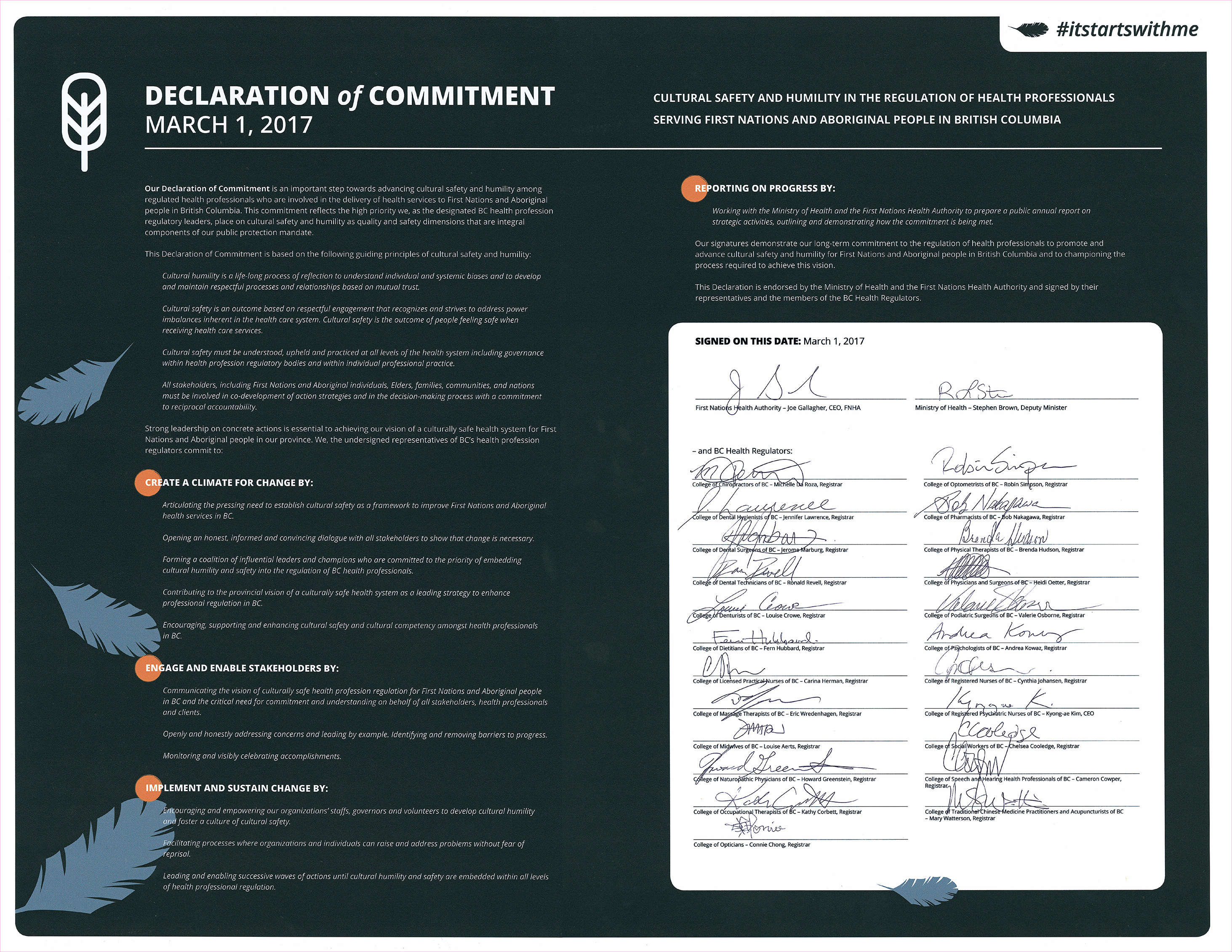
Signing this declaration committed the College and other health regulators to report on progress through annual reports, and outlining strategic activities and accountability measures that demonstrate how they are meeting their commitments to cultural safety.
This Declaration of Commitment reflected the high priority placed on advancing cultural safety and humility for Indigenous people among regulated health professionals by committing the Colleges to actions and processes intended to embed culturally safe practices within all levels of health professional regulation.
In order to fulfill this commitment the College developed a comprehensive strategy focused on improving BC pharmacy professionals’ work with Indigenous clients and communities.
In Plain Sight: Addressing Indigenous-Specific Racism and Discrimination in BC Health Care
Released in December 2020, the In Plain Sight: Addressing Indigenous-specific Racism and Discrimination in BC Health Care Report found significant evidence that the majority of Indigenous Peoples in BC have encountered racism and discrimination within our healthcare system, both as patients and as health care workers. Indigenous Peoples described unacceptable personal interactions and poorer quality of care, as well as feeling unsafe when accessing health care services and interacting with health providers.

This runs in direct opposition to our mandate which is to ensure that all British Columbians are provided with safe and ethical pharmacy care.
In Plain Sight places added urgency on the College to continue to work toward fulfilling its commitment to Cultural Safety and Humility for First Nations and Aboriginal peoples within our healthcare system.
The findings within the report reinforce the need to create a healthcare environment free of racism and discrimination, that ensures Indigenous people in BC can access and receive safe and equitable health care services.
The report also provides a number of recommendations that the College continues to incorporate into the way we regulate pharmacy professionals and serve Indigenous peoples.
Apologizing for Our Actions
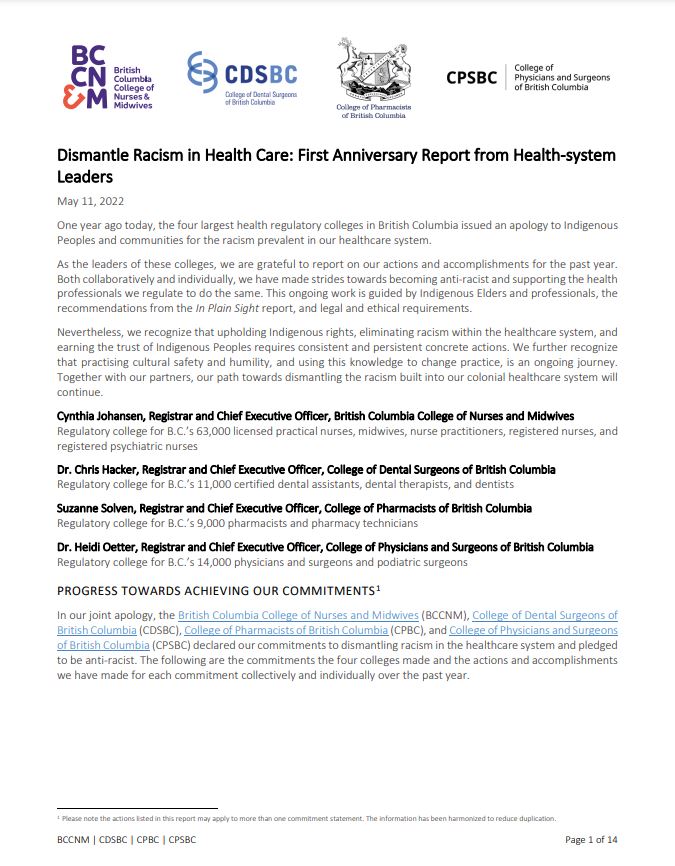
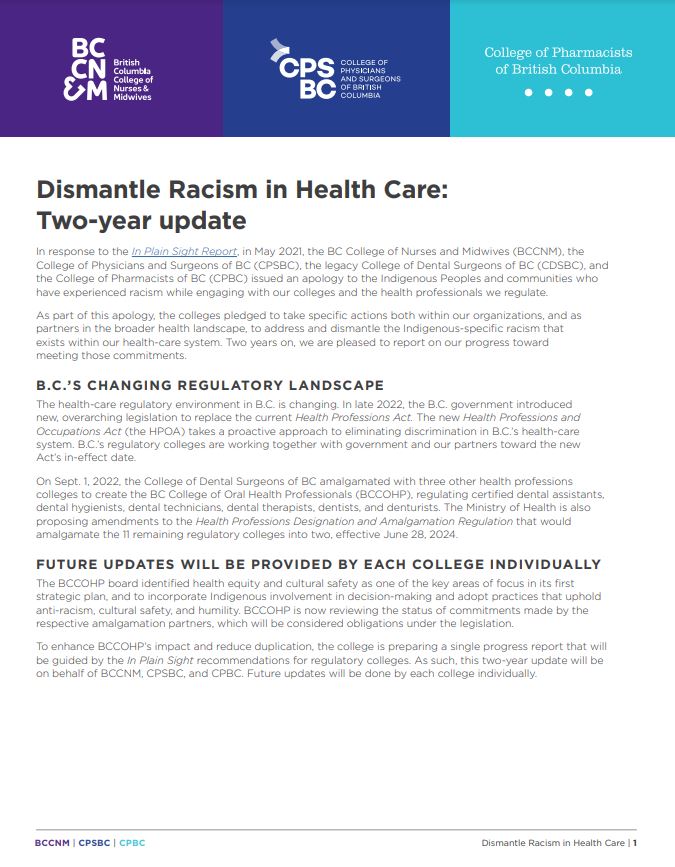
In response to the In Plain Sight Report, in May 2021, working alongside the College of Physicians and Surgeons of BC (CPSBC), the College of Dental Surgeons of BC (CDSBC), and the British Columbia College of Nurses and Midwives (BCCNM), the College issued an apology to the Indigenous peoples and communities who have experienced racism while engaging with us and the health professionals we regulate.
As part of this apology, the Colleges pledged to take specific actions both within our organizations, and as partners in the broader health landscape, to address and dismantle the Indigenous-specific racism that exists within our health care system.
A strategic pillar
In 2022, we embedded a commitment to Indigenous Cultural Safety and Humility directly into our strategic plan and organizational values. It was a deliberate choice to make this work foundational to how we regulate and serve the public. What has grown from that foundation reflects how much this commitment has come to mean, and how much further we intend to go.
AVAILABLE LEARNING ACTIVITIES for Health Professionals
As stewards of public health and safety in Canada, we have a responsibility to recognize and address the power imbalances inherent in our health care system, and work to ensure that the environments in which we practice are free of racism and discrimination, and that Indigenous people feel safe when receiving care.
Self-education for health professionals is especially important in addressing systemic racism and intolerance toward Indigenous worldviews and traditional approaches to health, as well as the enduring legacy of colonialism present in our healthcare system. All pharmacy professionals in BC must now complete a minimum of 3 hours of learning per year related to Indigenous Cultural Safety, Cultural Humility, and Anti-racism (ICSH/AR).
A commitment to self-education helps to remove the burden from Indigenous clients. Indigenous peoples face a unique set of issues, risks and challenges when it comes to accessing and receiving healthcare in Canada. As such, cultural safety and humility is an essential and ongoing process for health professionals to learn about and understand these issues and to recognize the barriers faced by Indigenous peoples within our healthcare system.
The following is a list of ICSH learning resources to help guide you as you begin your learning journey.
Learning Activity |
|
UBC Faculty of Pharmaceutical Sciences:
|
|
University of Saskatchewan: |
|
BC College of Nurses & Midwives (BCCNM): |
|
College of Physicians and Surgeons of BC (CPSBC): |
|
BC College of Oral Health Professionals (BCCOHP): |
|
First Nations Health Authority (FNHA): |
|
interCultural Online Health Network (iCON)
|
|
Ontario Federation of Indigenous Friendship Centres: |
|
Provincial Health Services Authority (PHSA): |
|
San’yas Anti-Racism Indigenous Cultural Safety Training Program:
|
|
University of Alberta / Coursera: |
Workshops and Experiential Learning |
|
Len Pierre Consulting: |
Reading Materials |
|
BC Centre for Disease Control (BCCDC): |
|
College of Pharmacists of BC (CPBC): |
|
Government of British Columbia: |
|
Health Quality BC: |
|
National Inquiry into Missing and Murdered Indigenous Women and Girls: |
|
Representative for Children and Youth (RCY): |
|
United Nations: |
Foundational commitments, reports, policies and Resources
To help pharmacy professional begin or continue their individual journeys toward truth and reconciliation, we have compiled a list of policies, reports, commitments, and other resources aimed at addressing and rectifying the historical and ongoing injustices faced by Indigenous Peoples in Canada.
Truth and Reconciliation Commission of Canada 94 Calls to Action
The Truth and Reconciliation Commission of Canada (TRC) was established as part of the Indian Residential Schools Settlement Agreement in order to provide those directly or indirectly affected by the legacy of the Indian Residential Schools system with an opportunity to share their stories and experiences.
In June 2015, the TRC held its closing event in Ottawa and presented the executive summary of the findings contained in its multi-volume final report, including 94 "calls to action" (or recommendations) to further reconciliation between Canadians and Indigenous Peoples.
United Nations Declaration on the Rights of Indigenous Peoples (UNDRIP)
The United Nations Declaration on the Rights of Indigenous People (UNDRIP) is a comprehensive international human rights instrument on the rights of Indigenous Peoples around the world. UNDRIP contains 46 articles outlining collective and individual rights, identifying states and governments as responsible for protecting and upholding these rights. The purpose of UNDRIP is to contribute to the survival, dignity and well-being of Indigenous Peoples.
- For additional Information please have a look at the National Centre for Truth and Reconciliation’s UNDRIP FAQs, as well as the Canadian Museum for Human Rights’ UNDRIP page.
BC Declaration on the Rights of Indigenous Peoples Act
BC’s Declaration on the Rights of Indigenous Peoples Act (DRIPA) commits the province to align its policies and laws with UNDRIP. The DRIPA Action Plan outlines the steps the province will take to address the inequities experienced by Indigenous Peoples, emphasizing reconciliation, respect for Indigenous rights, cultural revitalization, and collaboration on decision-making processes.
The actions contained in the plan are organized under the following four themes:
- Self-determination and inherent right of self-government
- Title and rights of Indigenous Peoples
- Ending Indigenous-specific racism and discrimination
- Social, Cultural and Economic Well-Being
National Centre for Truth and Reconciliation (NCTR)
The NCTR was created as part of the mandate of the Truth and Reconciliation Commission of Canada, and continues the work started by the TRC. The TRC created a historical record of the residential schools system. As part of this process, the Government of Canada provided over 5 million records to the TRC.
The NCTR is now the permanent, safe home for all statements, documents, and other materials gathered by the TRC.
The NCTR educates Canadians on the profound injustices inflicted on First Nations, Inuit and the Metis Nation by the forced removal of children to attend residential schools and the widespread abuse suffered in those schools.
The NCTR preserves the record of these human rights abuses and promotes continued research and learning on the legacy of residential schools.
National Inquiry into Missing and Murdered Indigenous Women and Girls
The National Inquiry into Missing and Murdered Indigenous Women and Girls was a federally funded inquiry that took place between 2016 and 2019 to investigate, report on and end the systemic and institutional causes of the disporportionately high levels of violence against Indigenous women and girls. The inquiry was also the Government of Canada's response to Truth and Reconciliation Commission Call to Action #41. The 2019 final report inclues 231 calls for justice.
- Reclaiming Power and Place: The Final Report of the National Inquiry into Missing and Murdered Indigenous Women and Girls
- National Inquiry into Missing and Murdered Indigenous Women and Girls Calls for Justice
- Missing and Murdered Indigenous Women, Girls, and 2SLGBTQQIA+ People National Action Plan
Remembering Keegan: A BC First Nations Case Study Reflection
Remembering Keegan: A BC First Nations Case Study Reflection provides an in-depth look at the tragic story of Keegan Coombes of Skwah First Nation. Keegan was a high school graduate, a grade-10 pianist and a chess champion living with developmental disabilities whose untimely death in hospital came as the result of a delayed diagnosis and improper clinical management of a treatable accidental poisoning. A first of its kind report, Remembering Keegan can help health professionals learn from and reflect on personal and systemic biases that shape their practice by exploring examples of what culturally safe care should look like, and how it could have contributed to a different outcome in Keegan's case.
Indian Residential School History & Dialogue Centre: Collections
The collections website of the Indian Residential School History and Dialogue Centre responds to the desire of residential school Survivors and their families to have increased access to residential school records. The Collections also support education about the history, legacy, and ongoing impacts of the Indian residential school system on Indigenous Peoples and Indigenous-settler relations in Canada.
The Centre's online database brings together digital copies of records that include:
- Survivor testimonies
- Truth and Reconciliation Commission events and hearings
- Photographs
- Maps and site plans
- Government documents
- Church documents
- Belongings
- Newspaper articles
- Library resources
ORANGE SHIRT DAY
Orange Shirt Day was born St. Joseph Mission Residential School Commemoration Project and Reunion events that took place in Williams Lake, BC, Canada, in May 2013. At the event, Esk’etemc (Alkali Lake) Chief Fred Robbins brought together residential school survivors and their families in order to honour them, help in the healing and contribute to reconciliation.
One of the speakers at the event was Phyllis Webstad, a Northern Secwepemc (Shuswap) woman and residential school survivor who told the story of the “orange shirt” given to her by her grandmother for her first day of school at St. Joseph’s Mission residential school in British Columbia.
The first Orange Shirt Day took place on September 30, 2013 in Williams Lake. In the years that followed, the Orange Shirt has become a national symbol of truth, reconciliation and the inter-generational impacts of Residential Schools in Canada.
Government Resources
- Maps of Indigenous Peoples and Lands
- Learning resources about First Nations, Inuit and Métis across Canada
- Government of British Columbia – Addressing Racism: Working Glossary
- Indian Residential School History & Dialogue Centre: Collections